
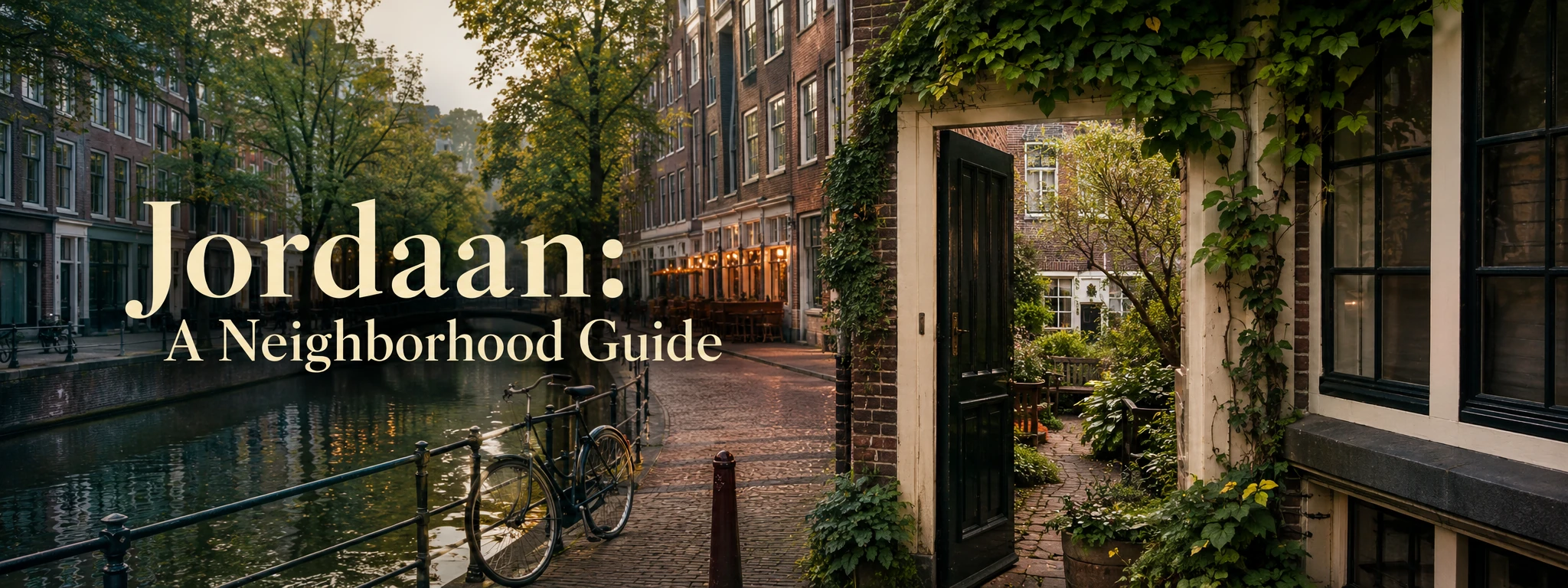

The Jordaan is best understood as a lived neighbourhood beside the canal ring, not a checklist attraction. Its narrow lanes, small canals, workshops, cafés and hidden courtyards reward a slow loop. It is also residential: the most memorable visit comes from noticing detail without treating doorways, homes or courtyards as a film set.
Start with the geography
The Jordaan sits west of Prinsengracht, roughly between Brouwersgracht and Leidsegracht. Streets follow older drainage lines rather than the grand canal ring, so navigation feels irregular. Pick one or two anchors—Noordermarkt in the north and the Nine Streets toward the south—then wander between them instead of repeatedly crossing the district.
A practical two-hour route
Begin at Noordermarkt, follow Westerstraat or the quieter lanes towards Egelantiersgracht, turn south through Bloemgracht and finish near Rozengracht or the Nine Streets. This route gives canals, small shops and brown cafés without retracing your steps. Add the Anne Frank House only with a timed ticket; do not build the day around obtaining one at the door.
Noordermarkt and market days
Noordermarkt changes character with its market programme. Saturday is the liveliest for food and browsing; Monday has a different, more local-feeling mix. Hours and stalls can change, so check the City of Amsterdam or market organiser before making a special trip. Outside market hours, the square is calmer and easier to appreciate.
Hofjes are homes first
Historic almshouse courtyards are among the Jordaan’s quietest spaces, but many remain residential and access is never guaranteed. Enter only through an open public entrance, keep voices low, do not photograph residents and leave immediately if a sign or closed gate indicates privacy. Sint Andrieshofje is a useful historic example; treat any opening as a privilege, not an entitlement.
If a doorway looks private, assume it is. The Jordaan is more enjoyable when you read its architecture from the street instead of chasing every “secret courtyard” on social media.
Where the atmosphere changes
The eastern edge near Anne Frank House and Prinsengracht is busiest. Parallel lanes become calmer within a few minutes. Westerstraat is broader and practical; Egelantiersgracht and Bloemgracht are prettier and quieter; Rozengracht is a major transport street rather than a canal-side stroll. Choose streets to match your mood rather than expecting one uniform district.
Eating and drinking well
The Jordaan has excellent brown cafés, modern restaurants and specialist shops, but no single “local” menu test guarantees quality. Reserve popular dinner spots, especially Thursday to Saturday. For a spontaneous visit, arrive before the evening rush and look at the current menu and recent reviews. Our brown cafés guide explains what to expect.
Shopping without turning the walk into a queue
Independent fashion, interiors, art and food shops are scattered rather than concentrated in one arcade. Browse side streets, then continue south to the Nine Streets if shopping is the priority. Opening hours are shorter on some Sundays and Mondays; verify a must-visit shop directly.
Crowds, bikes and accessibility
Footpaths are narrow and bikes, delivery vehicles and residents share the streets. Keep out of cycle lanes, cross tram and bike routes deliberately and avoid walking four abreast. Cobblestones, bridges and steps can challenge wheelchairs and pushchairs; the broader streets and canal edges provide easier alternatives, while historic courtyards may not be step-free.
Best time to visit
Weekday mornings are quietest. Saturday adds market energy but also the densest foot traffic. Early evening suits a café or dinner stop, while late weekend nights can be noisy around bars. Rain gives the canals atmosphere but makes brick and bridge surfaces slippery, so allow more time.
What to combine with the Jordaan
Pair it with Westerpark for green space, the Canal Ring for architecture or the Nine Streets for focused shopping. Avoid stacking it with three major museums: the district’s value lies in unplanned time. Two to three hours plus a meal is enough for a first visit without reducing it to a photo stop.
The verdict
Come for a coherent neighbourhood walk, not a collection of “hidden gems”. Start north, move south, respect residential spaces and let cafés or shops interrupt the route. That balance preserves what makes the Jordaan appealing while giving a first-time visitor a practical structure.
Checked against current Amsterdam visitor information in September 2026 — written by the Totally Amsterdam Team.