
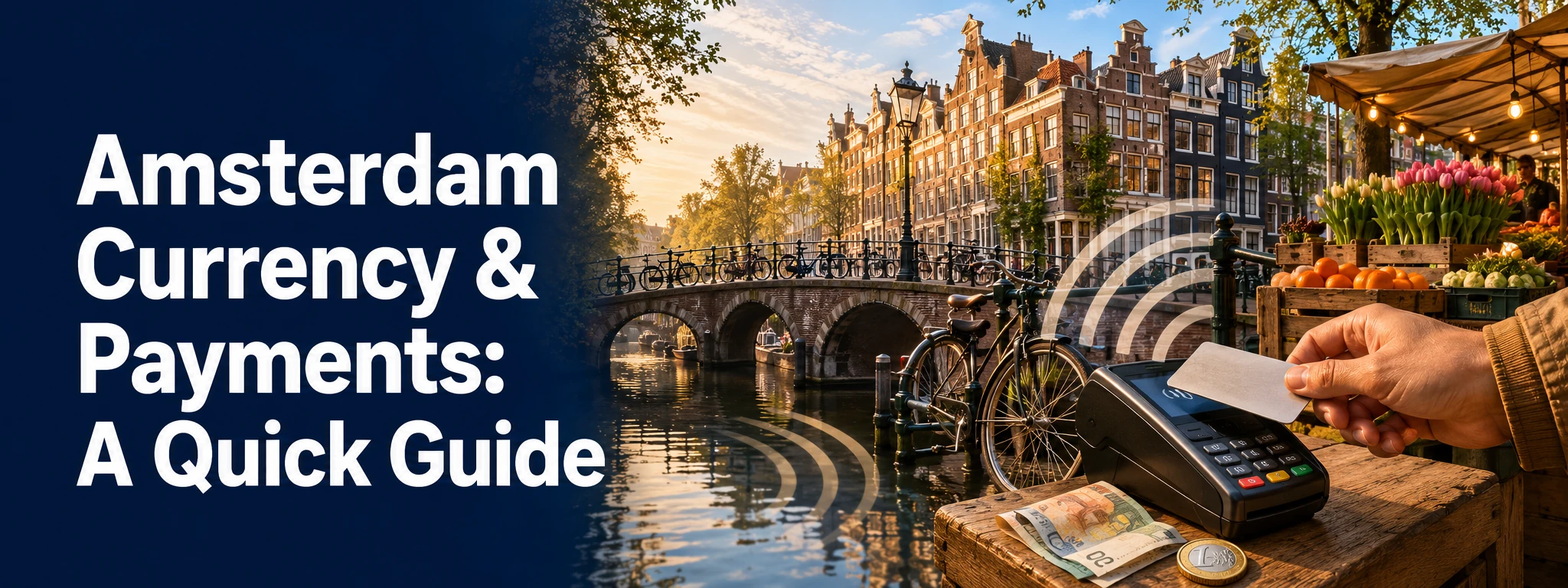
Amsterdam uses the euro and is easy to navigate with a contactless Visa or Mastercard, but the common claim that “you never need cash in the Netherlands” is too absolute. Dutch central-bank research published in July 2026 found that cash remains widely accepted nationally, while card-only outlets are more common in large cities such as Amsterdam.
The simplest visitor setup
Bring one contactless Visa or Mastercard for everyday spending, a backup card stored separately, and a modest amount of euro cash. That combination covers most restaurants, attractions, transport and shops without forcing you to hunt for an ATM when a terminal fails or a small business prefers cash.
GVB's OVpay system lets one traveller check in and out with the same contactless debit card, credit card, phone or smartwatch. It supports contactless Maestro, V PAY, Mastercard and Visa. Each traveller needs their own card or device.
Is Amsterdam really cashless?
No. DNB's 2025 field survey, published in 2026, found only a minority of Dutch outlets were explicitly card-only, although the share is higher in major cities. Market stalls were especially unlikely to be card-only. The practical lesson is not “carry lots of cash”; it is “do not assume cash is obsolete”.
Where cards are easiest
Museums, hotels, supermarkets, chain stores and most restaurants are strongly geared toward electronic payment. Contactless is normal for small purchases. Some businesses are card-only, particularly in urban settings where handling cash is considered inconvenient or a security cost.
Where cash can still help
Cash is useful as a backup during payment outages and at some markets, small independents or situations where your foreign card is rejected. DNB notes that retailers themselves often fall back to cash when electronic payments fail. A small reserve is therefore sensible even if you expect to pay electronically almost all week.
Using OVpay correctly
For pay-as-you-go public transport, tap in and tap out with the same physical card or same device. Do not tap in with a bank card and tap out with the same card stored in your phone wallet: the system can treat those as different payment tokens. One card/device is for one passenger, so a family cannot pass one bank card down the line at the gate.
Day tickets versus bank-card taps
OVpay is convenient when you want simple per-journey charging. A GVB day or multi-day product can make more sense if you expect repeated GVB tram, bus and metro journeys and prefer a fixed transport cost. GVB tickets are not automatically valid on every other operator, so compare the coverage rather than assuming one Amsterdam ticket covers all Dutch trains and regional buses.
Foreign cards and fees
Your Dutch merchant may charge in euros while your home bank adds its own foreign-transaction or currency-conversion fee. Check that fee before travelling because lots of small contactless purchases can magnify a poor card policy. Carrying a second network or bank also helps if a fraud system blocks the card you use most often.
ATMs
If you need cash, use an ATM whose fee and exchange-rate choice are clearly shown. Your home bank may add a withdrawal fee on top. When an ATM or payment terminal offers to convert the transaction into your home currency, compare carefully: paying in euros and letting your own card provider perform the conversion is often more transparent, but your own bank's terms still matter.
Do not rely on American Express alone
Acceptance is less universal than Visa or Mastercard. If Amex is your preferred rewards card, carry a widely accepted Visa or Mastercard as backup rather than discovering at a small restaurant that your only card is unsupported.
Emergency fallback
Keep a little cash and a second card separately from your wallet or phone. If your phone battery dies, a wallet is lost or electronic payments are disrupted, that small redundancy matters more than chasing the “perfect” travel-payment product.
Bottom line
Amsterdam is card-friendly, not cash-free. Use contactless for convenience, OVpay where it suits your transport pattern, keep a modest euro reserve, and know what your own bank charges. That is more robust than either carrying a large cash wallet or travelling with no physical fallback at all.
Reviewed against current official visitor guidance in September 2026 — written by the Totally Amsterdam Team.