
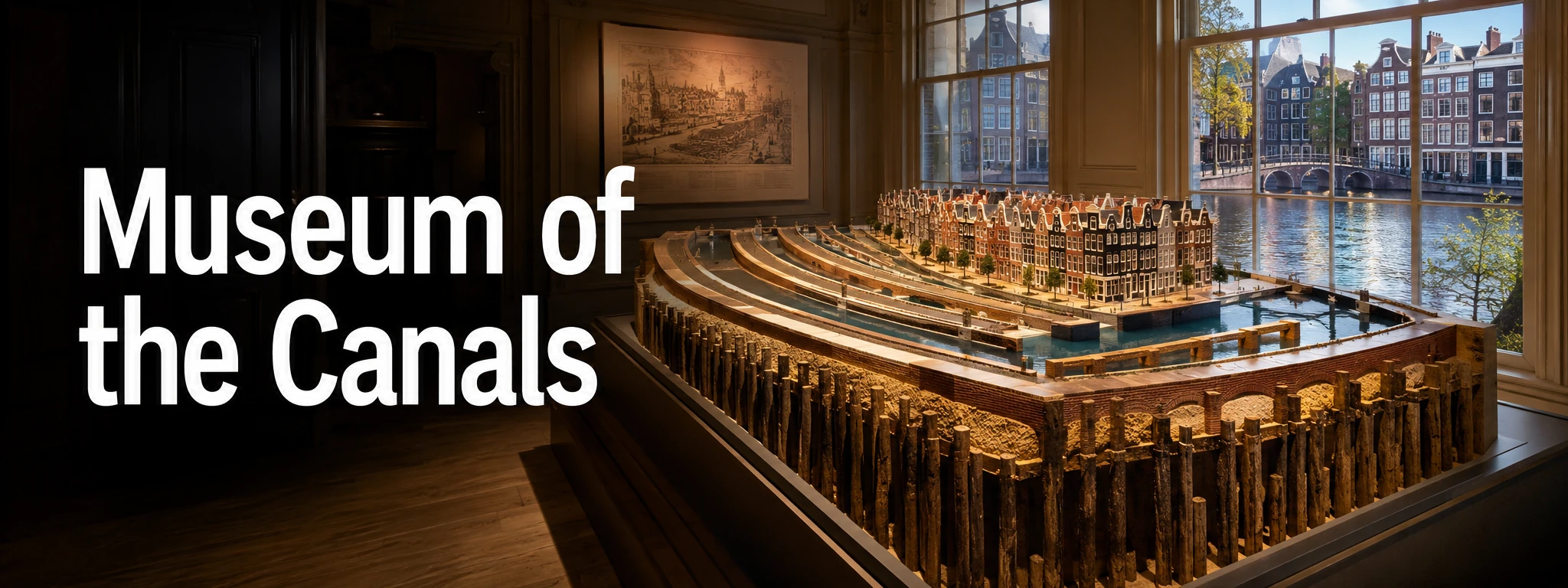
The Museum of the Canals — Grachtenmuseum — is one of the most focused museums in central Amsterdam. It is not trying to compete with the Rijksmuseum for a whole afternoon. Its job is to explain why the canal belt looks the way it does, how the city expansion was planned and what it took to build a grand urban district on wet ground. If the canal ring has otherwise felt like “pretty houses beside water”, this is the museum that supplies the missing diagram.
Who I think gets the most value from it
I would prioritise it for first-time visitors who enjoy city history, architecture or engineering; families with older children who want a compact museum; and anyone planning a canal cruise who would like the ring to make more sense before boarding. If your museum time is extremely limited and art is the priority, this is probably not your first ticket.
What the visit is actually like
The museum uses a sequence of rooms, models, projections and an included audio guide to tell the canal story. The official site says there are no live guided tours for ordinary visitors: the permanent and temporary exhibitions are experienced with the audio guide. That matters if you are choosing between this and a walking tour — they are different products, not substitutes.
Museum first, canal walk or cruise second. Once you understand the expansion plan, the Herengracht, Keizersgracht and Prinsengracht stop looking like three interchangeable waterways.
Opening hours checked for September 2026
The museum currently lists Monday 12:00–17:00 and Tuesday–Sunday 10:00–17:00. It lists closures on 25 December, 1 January and 27 April. Hours can change, so use the museum's own visit page if your day depends on a tight schedule.
Tickets, cards and whether you need a time slot
Adult admission is currently €18.50, with separate student and child rates. Museumkaart, Stadspas, I amsterdam City Card and ICOM are currently accepted for free admission under the museum's listed conditions. The museum says it does not use time slots; online e-tickets are available, but they do not provide priority entry. Payment is by debit or credit card and the museum says it does not accept cash.
Audio guide and language options
The included audio guide is currently offered in Dutch, English, German, French, Spanish, Italian, Russian, Japanese and Chinese. That makes this an unusually easy small museum to recommend to a mixed-language group without needing to coordinate separate guided-tour times.
Accessibility: useful specifics rather than a vague icon
The museum describes itself as wheelchair accessible and has a lift. Its accessibility page gives more useful detail: thresholds around 3 cm, a narrowest doorway of 80 cm, and no access for mobility scooters. A wheelchair can be borrowed if reserved in advance, and assistance dogs are permitted. There is also one disabled parking space opposite the entrance. If your chair or mobility device is near those dimensions, I would check directly with the museum before travelling.
How long should you allow?
This is a compact museum. I would budget roughly an hour for an unhurried visit, then leave extra time if you tend to replay audio or linger over models. The official site does not force a timed entry, which makes it easy to combine with a walk through the Nine Streets, the canal ring or the Anne Frank House area.
Location and the easiest pairing
The museum is at Herengracht 386, in the middle of the canal belt. The museum estimates the walk from Amsterdam Centraal at about 23 minutes (around 1.7 km) and recommends public transport, walking or cycling over driving because central parking is limited. The Nine Streets are about two minutes away; the Westerkerk and Anne Frank House are roughly ten minutes away according to the museum.
What is not here
There is no museum café. There is a small museum shop, and the official site points visitors to nearby cafés for food or coffee. That sounds minor, but it matters when you are using this as a one-hour stop between other canal-ring attractions.
Pair it with the right page
Read our corrected Canal Ring guide for the wider urban layout, then use the canal cruise guide if you want to see the plan from water level. I would not treat the museum as a replacement for either; it is the explanatory layer that makes both more interesting.
Sources checked 6 September 2026: Grachtenmuseum official times/prices, practical-information, directions/transport, FAQ and accessibility pages; UNESCO World Heritage Centre canal-ring listing.
Cheers, Carpe Diem & make the canals make sense! 🍻⏳🏛️
TATS Man
Small-museum advocate, big-picture canal nerd.