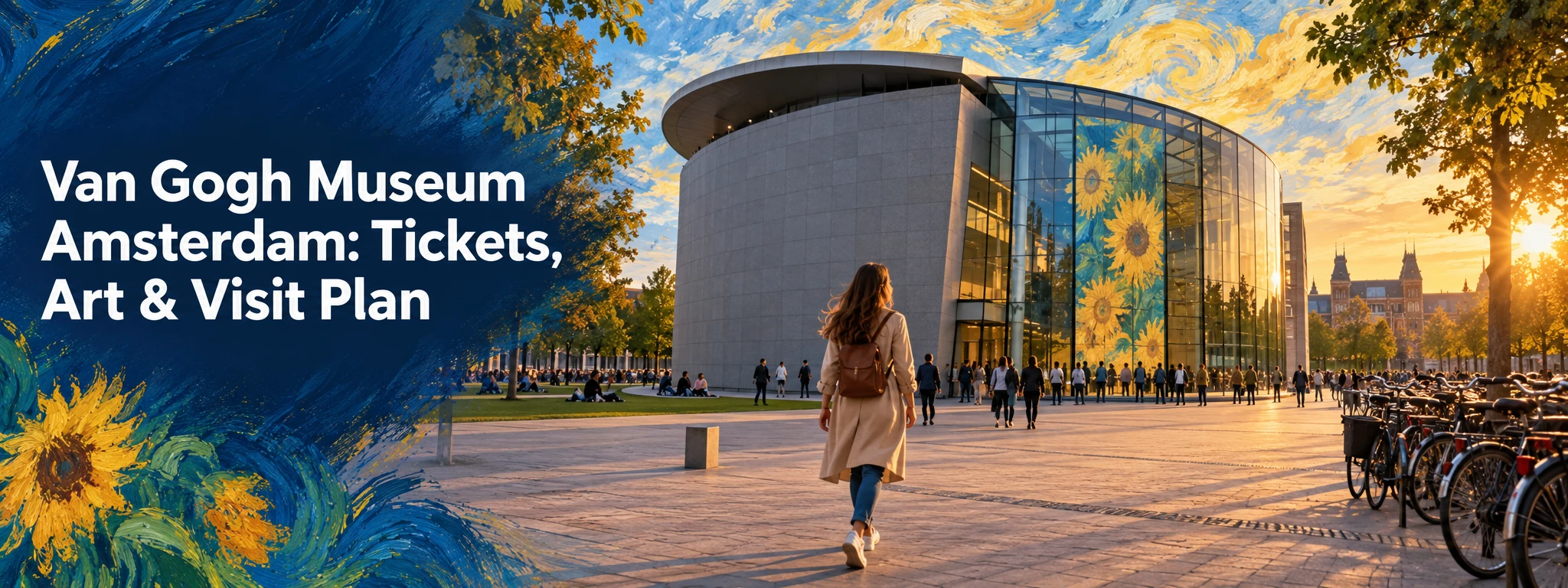
The Van Gogh Museum works best when you treat it as a biography told through paintings, drawings and letters rather than a checklist of famous canvases. The collection lets you watch Vincent van Gogh learn, experiment, fail, change colour palettes and absorb influences over a remarkably short career. Timed tickets are essential, so plan this museum before you improvise the rest of Museumplein.
2026 tickets: book a timed slot
The official ticket system currently lists regular adult admission at €25, visitors under 18 free and EU/EEA students at €16. Museumkaart and several recognised passes receive free admission, but each visitor still requires a valid ticket for the selected date and time. Regular tickets are non-refundable. Buy through the official Van Gogh Museum ticket site rather than assuming a reseller has equivalent availability.
An optional multimedia/audio tour is currently €3.75 for adults, with a lower youth rate. It is offered in multiple languages and is worthwhile for first-time visitors who want context without joining a guided group.
Opening hours: check your date
The museum's published hours vary by date and programme rather than being as simple as the Rijksmuseum's year-round schedule. Current official material shows regular daily opening and some extended Friday programming, while ticket products can have special entry windows. Use the museum's own calendar for your date instead of copying a generic closing time from an old travel article.
How long to allow
Allow around two hours for a strong first visit. Ninety minutes works if you focus on the permanent collection; three hours suits visitors who read letters, use the multimedia guide and include a temporary exhibition. A final-hour ticket can be useful for a focused highlights visit, but by definition gives you less time and should not be chosen if this is one of your main reasons for visiting Amsterdam.
Follow the development, not just the masterpieces
The museum is most rewarding when you follow Van Gogh chronologically. His early Dutch work is darker and earthier than the bright images many visitors expect. Paris introduces new colour and modern influences; Arles brings some of the most recognisable experiments with yellow, orchards, bedrooms and sunflowers; Saint-Rémy and Auvers show further changes in brushwork, landscape and emotional intensity.
This sequence makes the famous paintings more meaningful. You see that the “Van Gogh style” was not a single fixed look but something he built through relentless study and rapid change.
What you may — and may not — see
The museum holds the world's largest collection of works by Van Gogh, but no museum displays every famous work at all times. Paintings can be on loan, under conservation or rotated. Do not build your entire visit around seeing one specific canvas without checking current display information. The permanent collection's strength is the arc of the career, not possession of every image you know from posters.
Letters are part of the story
Van Gogh's correspondence, especially with his brother Theo, is essential to understanding his working life. Slow down when the galleries use letters to explain what he was trying to achieve, which artists he admired and how he thought about colour. They turn the museum from a greatest-hits display into a record of an artist thinking in real time.
Japanese prints and artistic influences
Van Gogh collected Japanese prints and studied their cropping, flattened spaces and strong outlines. He also learned from Impressionism, Neo-Impressionism and contemporaries he encountered in Paris and the south of France. Look for those connections rather than viewing him as an isolated genius who invented his visual language from nowhere.
Temporary exhibitions in late 2026
The programme changes throughout the year. As of late August 2026, the museum has announced Yoshitoshi. Master of the Moon from 1 October 2026 to 4 January 2027 and Whistler. Dandy and Disruptor from 16 October 2026 to 10 January 2027, alongside special Friday events. Check whether a temporary exhibition needs its own reservation or changes the amount of time you should allow.
Best time of day
A timed system controls arrivals but does not make the galleries empty. Earlier slots are attractive because you start fresh and can spend the rest of the day on Museumplein; later visits can work well if you have already done outdoor sightseeing. The more important strategy is to avoid rushing because another fixed booking begins immediately afterward.
Audio tour or no audio tour?
Use the multimedia tour if this is your first serious encounter with Van Gogh. Skip it if you already know the chronology and prefer reading labels selectively. Either way, do not feel obliged to activate commentary at every stop. The strongest museum visits alternate focused looking with context rather than turning every painting into an audio task.
Families and teenagers
Under-18 admission is free, but a timed ticket is still required. With children, make the visit shorter and more visual: choose colours, self-portraits, landscapes and favourite paintings rather than attempting a complete art-history lesson. Teenagers who know the popular mythology around Van Gogh often respond well to the letters because they complicate the simplified “tortured genius” story.
Accessibility and luggage
The museum provides accessibility support and allows a free companion for visitors who cannot navigate independently; reserve the appropriate ticket through the official system. Large luggage cannot simply be assumed to fit in a museum cloakroom, so leave suitcases at your accommodation or a proper luggage facility before coming to Museumplein.
Getting there and Museumplein planning
The museum is at Museumplein 6, next to the Rijksmuseum and near the Stedelijk Museum and Concertgebouw. Tram and bus services connect Museumplein with the centre and other districts. If you are visiting two museums in one day, put a meal, park walk or café break between them. The geographical convenience is real; museum fatigue is equally real.
Van Gogh Museum or Rijksmuseum?
Choose Van Gogh for a deep, coherent story centred on one artist and his network. Choose the Rijksmuseum for a broad sweep of Dutch art, history and decorative culture. If you have only one museum slot, the decision should reflect your interests rather than which attraction appears higher on a generic “top ten Amsterdam” list.
Common mistakes
- Assuming free or pass-based admission means no reservation is needed.
- Buying from a reseller before checking official ticket availability.
- Expecting every famous Van Gogh painting to be on display.
- Skipping the early work and rushing straight to bright Arles paintings.
- Booking the Rijksmuseum immediately afterward with no recovery time.
- Bringing large luggage to Museumplein.
Official sources
We checked the Van Gogh Museum's official ticket system, current visitor information and 2026 cultural programme on 30 August 2026. Ticket prices, hours, exhibitions and entry products can change, so confirm your exact date on the official site before travel.
Last reviewed: 30 August 2026 — written by the Totally Amsterdam Team.